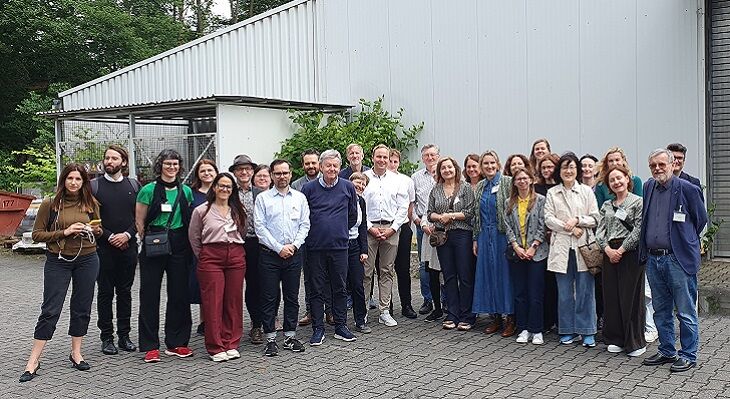
The proceedings from the ReferNet partners’ meeting in Bonn in May 2026 are now available! They capture the wide range of thematic discussions, with a particular focus on the recognition of foreign qualifications, excellence, mobility and AI in vocational education and training.
The dataset for the Timeline of VET policies in Europe is now available to researchers. It enables an in-depth analysis of the developments documented by ReferNet since 2015. The data is accompanied by a readme file providing all the background information.
This online tool is a rich source of information on policies and initiatives in the field of VET and lifelong learning in the EU, Iceland and Norway. Cedefop has now published the data provided by ReferNet in 2025.
At a meeting of the ReferNet network in May, in-depth discussions took place at the BIBB on current developments in VET across Europe. The focus was on recognition of foreign qualifications, excellence, international mobility and AI. A company visit gave a practical insight into the dual training.
On 20-21 May 2026, the ReferNet team at BIBB, together with Cedefop, is hosting a partner meeting of the network. The focus is on current developments in VET in Europe, such as the recognition of foreign qualifications, excellence and artificial intelligence in VET.
Cedefop invites applications for the position of Expert in Research and Policy Analysis. The deadline for applications is Thursday 21 May 2026 at 13:00 Greek time (CET+1).
Cedefop in Thessaloniki is offering paid 10-month internships starting on 1 October 2026. Application deadline: Tuesday, 21 April 2026, at 13:00 Greek time (CET+1)!
The latest ReferNet Spotlight focuses on the main features of the VET system in Cyprus, as well as the challenges faced and policy responses. It was published on the occasion of Cyprus Presidency of the Council of the European Union in the first half of 2026.
How are digitalisation and artificial intelligence affecting the world of work and the relationship between the supply and demand for skills? An analysis by Cedefop of the second wave of the European Survey on Skills and Employment.
Cedefop's new Spotlight format offers insights into the labour market landscape, future trends and forecasts of skills needs. The analysis, developed in consultation with the German ReferNet team, is based on various Cedefop tools.
This paper focuses on public financing of adult learning for individuals and companies in Germany. It also looks at current debates and the issue of data availability.
The Cedefop ReferNet database is the main source of information on VET systems in the EU, Iceland and Norway. It includes diagrammes, generates reports and allows comparing by country and theme. The 2023 update is now online.
describes the German VET system. It outlines the key features as well as the challenges and policy responses, e.g. an attractive VET for all and how to deal with the challenges of digitalisation and the commitment to sustainability.
An overview of vocational education and training initiatives and programmes in Germany in 2023, successful approaches and challenges from the perspective of European priority setting.
What skills and occupations are needed for the green transition? In this compilation by ReferNet Germany, projects forecasting future skills needs are briefly presented. They are an important basis for securing the qualification profiles needed in the future on the labour market.
This article presents the concept of dropping out of VET and the situation in Germany based on two indicators. Further, the focus is on the preventive measures in place to prevent drop-out as well as factors that can lead to early leaving from VET. The impacts of the COVID 19 pandemic conclude the report.
How can professional development help in-company trainers and VET school teachers adapt to the new demands of digitalisation, diversity and environmental crisis, and acquire the necessary skills? This report focuses on Germany.
gives an overview of the vocational educational and training (VET) system in Germany: external factors influencing VET; providing VET in a lifelong learning perspective; shaping VET qualifications and promoting participation in VET.
describes the German VET system. It outlines the key features as well as the challenges and policy responses, e.g. an attractive VET for all and how to deal with the challenges of digitalisation and the commitment to sustainability.
focuses on the responsiveness of the German VET system to the challenges of digitalisation, AI and the future of work. What are the policy strategies and initiatives to modernise VET and how can digital technologies and media support learning practices?
presents enablers and disablers of international long-term mobility of apprentices, with regard to: German framework conditions (Chapter 1), the VET system (Chapter 2) as well as practical implementation (Chapter 3).
gives an overview of the vocational educational and training (VET) system in Germany: external factors influencing VET; providing VET in a lifelong learning perspective; shaping VET qualifications and promoting participation in VET.