Cedefop's new Spotlight format offers insights into the labour market landscape, future trends and forecasts of skills needs. The analysis, developed in consultation with the German ReferNet team, is based on various Cedefop tools.
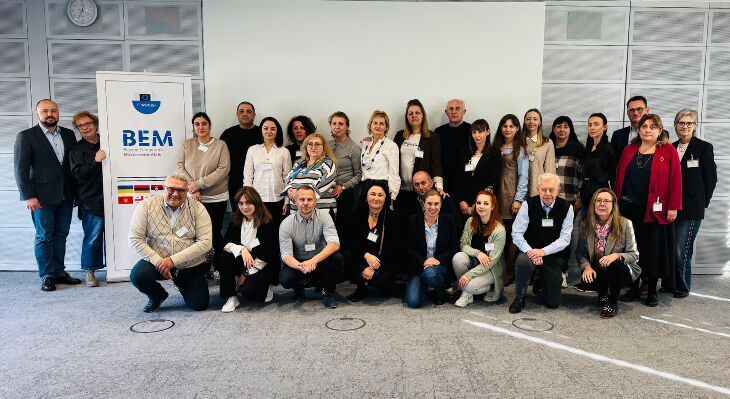
At an international expert meeting held at the BIBB in early November, experts from ten countries discussed whether and to what extent microcredentials contribute to social inclusion and could be usefully introduced in different national contexts.
This year's meeting of ReferNet partners from 29 European countries on 22–23 October 2025 focused on discussions about current policy developments in vocational education and training and the joint work programme for 2026.
On 11 September in Herning, Denmark, the ministers responsible for VET in the EU Member States adopted a declaration on VET for 2026-2030. The focus is on the challenges of integrating artificial intelligence, ecological and demographic change, as well as mismatch problems and skills shortages.
This ReferNet report focuses on public financing of adult learning for individuals and companies in Germany. It also looks at current debates and the issue of data availability.
Tackling the shortage of skilled workers by offering more attractive vocational training opportunities is to be the focus of a new agreement on European cooperation in VET. The Danish EU Presidency will work towards a corresponding declaration. This will replace the Osnabrück Declaration from 2020.
According to the European Commission, EU competitiveness is impaired by a shortage of skills and labour, among other things. The Union of Skills strategy aims to raise the level of qualifications, make it easier for companies in the EU to recruit staff and attract top talent from abroad.
How can recognition procedures improve mobility and skills utilisation in the EU? A new Cedefop paper provides an up-to-date overview of instruments and methods for the comparability and recognition of VET qualifications in Europe – partly based on contributions from the ReferNet network.
The online survey is part of a Cedefop study on ‘Deepening on Microcredentials – labour market sector relevance, quality and inclusion’. It will help to build an inventory of how microcredentials are structured, delivered, and recognised. Take part now until 18 July 2025!
Cedefop's new Spotlight format offers insights into the labour market landscape, future trends and forecasts of skills needs. The analysis, developed in consultation with the German ReferNet team, is based on various Cedefop tools.
This paper focuses on public financing of adult learning for individuals and companies in Germany. It also looks at current debates and the issue of data availability.
The Cedefop ReferNet database is the main source of information on VET systems in the EU, Iceland and Norway. It includes diagrammes, generates reports and allows comparing by country and theme. The 2023 update is now online.
describes the German VET system. It outlines the key features as well as the challenges and policy responses, e.g. an attractive VET for all and how to deal with the challenges of digitalisation and the commitment to sustainability.
An overview of vocational education and training initiatives and programmes in Germany in 2023, successful approaches and challenges from the perspective of European priority setting.
What skills and occupations are needed for the green transition? In this compilation by ReferNet Germany, projects forecasting future skills needs are briefly presented. They are an important basis for securing the qualification profiles needed in the future on the labour market.
This article presents the concept of dropping out of VET and the situation in Germany based on two indicators. Further, the focus is on the preventive measures in place to prevent drop-out as well as factors that can lead to early leaving from VET. The impacts of the COVID 19 pandemic conclude the report.
How can professional development help in-company trainers and VET school teachers adapt to the new demands of digitalisation, diversity and environmental crisis, and acquire the necessary skills? This report focuses on Germany.
gives an overview of the vocational educational and training (VET) system in Germany: external factors influencing VET; providing VET in a lifelong learning perspective; shaping VET qualifications and promoting participation in VET.
describes the German VET system. It outlines the key features as well as the challenges and policy responses, e.g. an attractive VET for all and how to deal with the challenges of digitalisation and the commitment to sustainability.
focuses on the responsiveness of the German VET system to the challenges of digitalisation, AI and the future of work. What are the policy strategies and initiatives to modernise VET and how can digital technologies and media support learning practices?
presents enablers and disablers of international long-term mobility of apprentices, with regard to: German framework conditions (Chapter 1), the VET system (Chapter 2) as well as practical implementation (Chapter 3).
gives an overview of the vocational educational and training (VET) system in Germany: external factors influencing VET; providing VET in a lifelong learning perspective; shaping VET qualifications and promoting participation in VET.